Hollywood stardom has always relied on images as much as performances.
Carefully crafted portraits taught audiences how to look at fame, beauty, power, and vulnerability.
Across decades, photographers helped construct stars as myths while allowing flashes of humanity to surface.
Ten portraits, created across different eras, reveal how visual strategies shaped celebrity culture.
Photography did not simply record stardom. Photography actively built it.
Let us take a look at the top ten portraits that actually made Hollywood’s visual representation what it is, both from the Golden Age and modern times.
1. Audrey Hepburn by Bob Willoughby, 1950s
View this post on Instagram
Bob Willoughby reshaped Hollywood photography by moving freely through film sets and private moments, treating production environments as living spaces rather than staged backdrops.
Portrait sessions with Audrey Hepburn reveal ease and openness rarely associated with studio-era stars.
Hepburn often appears mid-gesture, smiling without performance, sometimes cradling a small dog during a late-1950s shoot.
Posture remains relaxed. Expression feels unguarded. Light settles naturally across her face instead of carving dramatic contours.
Willoughby approached stars as active participants within unfolding stories.
Camera movement followed the behavior rather than directing it. Such practice shifted celebrity portraiture toward intimacy and emotional presence.
Audiences encountered Hepburn not only as an icon but as a person capable of gentleness, humor, and uncertainty. Celebrity imagery gained emotional proximity, altering how stardom functioned in popular imagination.
2. Marlene Dietrich by Don English, 1930s
View this post on Instagram
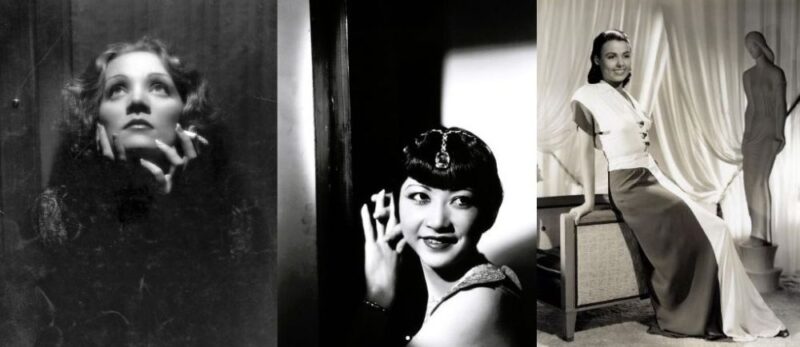
Marlene Dietrich’s 1932 portrait fused cinema aesthetics with photographic precision.
Strong shadows sculpt facial planes with near-architectural control, echoing lighting traditions associated with Josef von Sternberg.
Cheekbones emerge sharply. Eyes command attention. Head position suggests authority and mystery.
Paramount relied on these portraits to define its glamour ideal during the early sound era. Dietrich transformed into a constructed symbol rather than a spontaneous personality.
Photography operated as a strategic instrument, guiding audience perception through carefully maintained visual rules.
Glamour portraiture gained institutional importance as studios learned to manage fame through imagery.
3. Leonardo DiCaprio by John Russo, Contemporary Era
View this post on Instagram
John Russo’s portrait of Leonardo DiCaprio shows restraint as an intentional visual position rather than a lack of creative ambition.
Every decision within the frame favors control, balance, and psychological presence.
Image construction avoids spectacle, inviting viewers to linger on expression rather than styling.
Seated against a grey backdrop, DiCaprio appears reflective and contained. Posture remains steady.
Gaze feels inward, suggesting thought rather than performance.
Background neutrality removes narrative cues, leaving the character as the primary focus. Clothing reinforces this choice by avoiding trend-driven statements or decorative excess.
Minimal structure directs attention toward internal life instead of outward display.
Russo draws clear influence tied to classical studio portrait traditions, where restraint signaled seriousness and permanence.
Emotional openness, however, aligns with contemporary expectations that value sincerity over theatrical dominance.
Modern audiences respond to images that suggest depth without explanation. DiCaprio’s portrait reflects that cultural shift through quiet intensity and measured vulnerability.
Confidence emerges through stillness. Celebrity portraiture here becomes an exercise in trust, allowing subtle expression to carry meaning without amplification.
4. Humphrey Bogart by Scotty Welbourne, 1930s
Scotty Welbourne photographed Humphrey Bogart during a career transition that demanded visual reinvention.
Heavy contrast and deep shadows frame a guarded expression marked by tension. Jawline appears clenched.
Eyes suggest calculation and resistance.
Bogart’s image helped define Hollywood masculinity during the mid-1930s. Emotional reserve replaced romantic idealism.
Visual language associated with noir began forming through portraits like this one before genre conventions fully emerged on screen. Later roles built upon these established visual signals.
5. Anna May Wong by Otto Dyer, 1930s
View this post on Instagram
Anna May Wong’s portrait presents elegance shaped by restriction.
Ornate costume details and measured stillness reflect roles assigned to her within a narrowly defined system.
Styling emphasizes exotic symbolism, yet facial expression conveys intelligence and restraint rather than exaggeration.
Hollywood frequently confined Asian-American performers to fixed visual categories. Wong’s portraits quietly resisted those constraints through dignity and poise.
Strength appears through control rather than spectacle.
Viewed today, her image signifies self-possession maintained within an industry that restricted opportunity.
Photography preserved her authority even as cinema denied her narrative range.
6. Buster Keaton by MGM Archive, 1930s
View this post on Instagram
Buster Keaton’s silent-era portrait relies on reduction.
Blank background, frontal composition, and an immobile expression remove excess detail.
Meaning arises through stillness and restraint.
Creative struggles during Keaton’s MGM period contrast sharply with the endurance of his visual identity.
Without dialogue or exaggerated movement, emotional depth remains unmistakable. His face became visual shorthand for silent comedy grounded in understatement.
Photographic restraint supported the emotional precision that defined his screen presence.
7. Lena Horne by Clarence Sinclair Bull, 1940s
View this post on Instagram
Lena Horne’s MGM portrait projects sophistication through controlled lighting and refined styling.
Facial features receive gentle emphasis, producing a calm and confident presence.
Wardrobe and posture align her image with Hollywood elegance historically reserved for white performers.
Major studios rarely extended such treatment to Black performers during the 1940s.
Horne’s image challenged restrictive beauty standards and expanded visibility within mainstream cinema. Glamour, professionalism, and confidence coexist within her portrait.
Photography helped establish a new visual standard for Black stardom during a period of limited representation.
8. Zendaya by Jack Davison, Contemporary Era
View this post on Instagram
Jack Davison’s portrait of Zendaya presents a controlled tension between softness and authority.
Framing favors closeness, allowing subtle shifts in expression to carry emotional weight.
Shadows partially obscure the face, encouraging viewers to engage slowly rather than consume the image instantly.
Editorial polish remains present, yet intimacy dominates the composition.
Zendaya appears grounded and self-possessed rather than styled as a spectacle. Fashion functions as context instead of a distraction.
Image construction positions her simultaneously as a cultural figure and a serious performer.
Such portraiture reflects a generational shift where youth, introspection, and authority coexist without contradiction.
9. Timothée Chalamet by Craig McDean, Contemporary Era
View this post on Instagram
Craig McDean’s portrait of Timothée Chalamet embraces risk and visual play.
Lighting experiments introduce sharp contrasts and unexpected highlights.
Pose and styling reject neutrality, leaning into provocation and theatrical confidence. Energy feels restless rather than composed.
Chalamet appears aware of his image and willing to disrupt it. Heartthrob familiarity collides with cinematic ambition.
Editorial portraiture here becomes performative rather than restrained, reflecting contemporary celebrity culture that rewards boundary-pushing and visual daring.
10. Greta Garbo by Clarence Sinclair Bull, 1930s
View this post on Instagram
Clarence Sinclair Bull’s portraits of Greta Garbo shaped one of MGM’s most carefully controlled star images.
Sculptural lighting defines facial planes with precision. Soft focus smooths detail while preserving structure.
Poses feel deliberate, almost architectural, reinforcing emotional distance.
Garbo’s image thrived on mystery and restraint. Emotional withdrawal became part of her public persona.
Studio photography functioned as myth-making, turning the absence of access into fascination.
Such portraits demonstrate how Hollywood used visual control to cultivate enduring star mystique during the 1930s.
Closing Thoughts
Each portrait discussed captures more than a famous face.
Cultural values, power structures, and aesthetic priorities are embedded within every frame.
Photographers shaped how fame looked and how audiences related to it.
Candid intimacy, studio control, minimalist restraint, and symbolic resistance coexist across these images.